
We Built a Free Tool Route Setters Never Asked For, Part Two: Why I Won't Charge For This
What happens when the deployment bottleneck collapses — and what we owe the people it frees.


This is a continuation of a Previously Posted Article
Last week I built a four-tool suite for the professional route setting community. Hold taxonomy, hold catalogue, route recombination engine, visual route builder. A complete system that would have required a development team, six months of work, and significant capital to produce.
It took an afternoon.
I’m releasing it free. CC BY-NC-SA 4.0. Non-commercial, share alike, credit required. I want to explain why — not the tactical licensing rationale, but the actual reason — because I think it points at something that matters well beyond climbing.
The Deployment Bottleneck Just Collapsed
There’s a gap that has always existed between knowing something and making it usable by others.
A reasonably experienced chump like me, and certainly a subject matter expert — a route setter with a decade of embodied knowledge about how bodies move on walls — has always been able to describe what a good tool would do. The gap was execution. Development time. Team overhead. Cost. The infrastructure required to take expertise from inside one person’s head and turn it into something other people could use.
That gap used to be enormous. It meant that tools got built for markets big enough to justify the cost. Communities too small, too specialized, too economically marginal got nothing. Not because the knowledge wasn’t there. Because the deployment mechanism wasn’t. Climbing is growing year to year, it isn’t the perfect underdog example these days, but it’s the one I know, and there are plenty of small local institutions holding on, to say nothing of the DIY home wall crowd.
Big, medium, or mom and pop, AI has collapsed that gap. Not eliminated — collapsed. The distance between “I know exactly what this tool should do” and “this tool exists and works” shrunk from months and tens of thousands of dollars to an afternoon and a clear head.
When that happens, the economics of who gets tools changes. Radically.
The Old Model Is Taxing a Bottleneck That No Longer Exists
Here’s where it gets uncomfortable.
The pricing model most people are applying to AI-assisted tools was designed for the old gap. High development cost → price accordingly → recoup investment → generate return. That model made sense when building something real was hard and expensive.
When a tool takes an afternoon to build, charging subscription prices for it is not valuing the expertise behind it. It’s taxing the bottleneck that no longer exists — and passing that cost to the people who can least afford it.
Think about who gets priced out. The 5’1” V12 climber at a small gym in Hawai’i. The mom-and-pop climbing program running on donated holds and volunteer labor. The community that has the knowledge but never had the capital to turn it into infrastructure.
If everyone who builds a useful AI-assisted tool charges a hundred dollars a month for something that took an afternoon to create, we end up in a world where AI’s most democratizing potential gets captured behind a paywall. The same people who were locked out before get locked out again — just with shinier doors.
That’s not innovation. That’s the old extraction model wearing new clothes.
AI Gravity — The Positive Case
At Systemically Foolish, we’ve written about AI Gravity — the invisible pull AI creates inside workflows, dragging decisions and judgment into its orbit before governance catches up. That’s the risk case. The attractor that pulls human oversight into dependency before anyone notices.
This is the other side of that force.
AI Gravity also means that when a subject matter expert sits down with an AI, the pull is toward deployment. Knowledge that was trapped in one person’s head — or in a community’s collective but unstructured expertise — gets pulled into a form that’s usable, shareable, and improvable by everyone.
The route setting community has more domain expertise in a single Facebook group than most software companies will ever understand about anything they build. They’ve been solving the body variance problem, the hold inventory problem, the equity problem in setting — informally, through mentorship, through institutional memory that walks out the door when a setter leaves.
They lacked the deployment mechanism, or certainly the smaller independent spots still do. AI is that mechanism.
Not the knowledge. Not the judgment. Not the years of watching bodies move on walls and understanding why this hold in this position on this angle creates this movement for this body type and not another. Just the mechanism that takes all of that and makes it a tool someone else can use tomorrow.
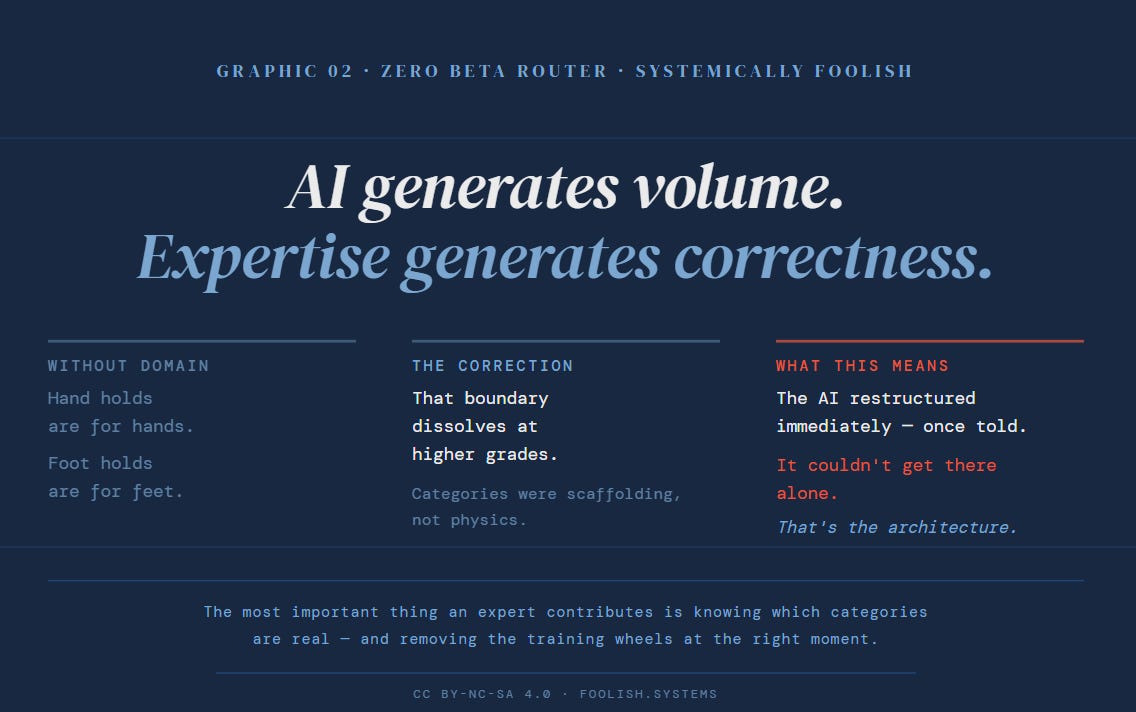
When the mechanism is cheap and the knowledge is the scarce thing — the economics should reflect that. The mechanism shouldn’t cost more than the knowledge.
The Culture You Bring Is Load-Bearing
There’s a piece of this that doesn’t get talked about enough in discussions of AI capability.
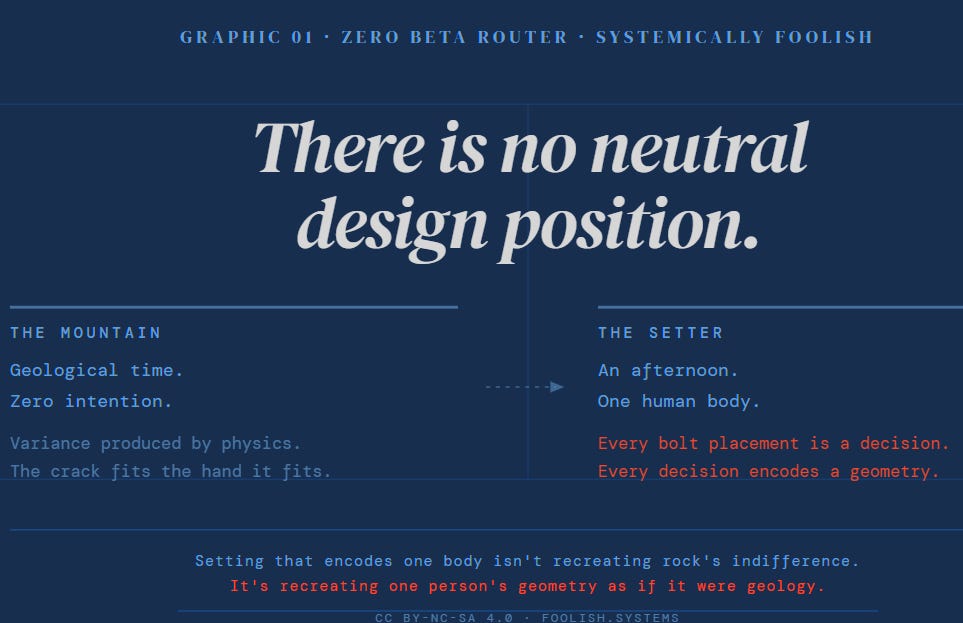
When I sat down to build the Zero Beta Router, the AI didn’t just execute instructions. It flagged a copyright concern about manufacturer hold photos before I raised it — and proposed a better solution: let the community be the image library. It noticed the taxonomy was clean enough to become a database schema before I did and said so. When I mentioned the equity problem with reachy setting, it didn’t bolt equity flags on as an afterthought — it built them into the hold data from the start.
That’s not magic. That’s what happens when you bring a clear set of values to the work. But it’s also not the default setting either. Good design and building (just like route setting), requires applied friction and tension, but put it at the wrong spot and everything falls apart.
At Systemically Foolish, we’ve spent a long time thinking about how humans and AI actually work together — not in the abstract alignment theory sense, but in the practical daily sense of: what culture do you bring to the conversation, and how does that shape what comes out the other side?
An AI working with someone who says “build me a thing I can sell” produces a sellable thing. An AI working with someone who says “build me a thing that raises the floor for everyone, and here’s why the equity considerations are non-negotiable” produces something different.
The model is the same. The afternoon is the same. The output is determined by what the human insists matters.
That’s not a small claim. It means that the most consequential variable in AI-assisted work isn’t the model capability — it’s the values the human brings to the interaction. The culture of the collaboration is load-bearing. It’s the difference between a tool that extracts and a tool that serves.
We insisted that a 5’1” climber matters as much as a 6’2” one. We insisted the tool is free. We insisted improvements stay in the commons. The AI built accordingly — not because we forced it, but because when you’re clear about what matters, the work follows.
What This Connects To
The Zero Beta Router is one instance of a pattern Systemically Foolish is building toward systematically.
The pattern: find things we care about, that we know, or that we want to learn about, and find meaningful or interesting ways to engage and contribute. AI can help raise the floor, or it can leave those who are already marginalized further behind.
We do it with research tools. We do it with education and outreach. And now we do it with climbing hold taxonomies too apparently.
The thesis is simple: when building costs an afternoon and expertise is the actual scarce resource, the correct response is to build fast and give generously. Capture the return through credibility, through trust, through being the organization that keeps showing up with tools that work and releasing them without a subscription model attached.
The floor rises for everyone or it doesn’t rise at all. That’s not a nice tagline. It’s a systems design constraint. A floor that rises only for people who can pay for it isn’t a rising floor. It’s a ceiling that moved.
Why It Matters That We Got This One Right
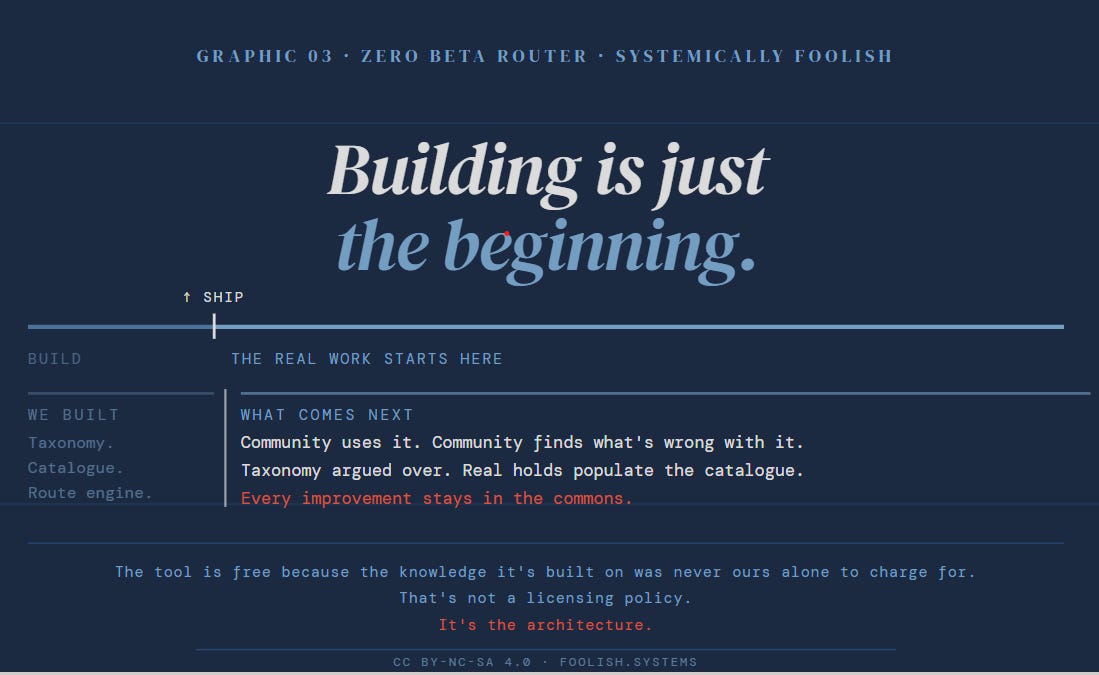
The routesetting community is a useful test case precisely because it’s small, specialized, and while the needs are different they scale similarly. More importantly the knowledge was there. The problem was real. And more importantly, just because it’s free doesn’t mean we release it and call it a day. We’re committed to improving it. If we can spare an hour or two to make it, we can spare another to keep it going. (In fact we already released the first patch.)
If this model works for climbing — and we think it does — it works for every community that has deep domain expertise and uneven deployment infrastructure. Which is most communities. Most of the knowledge that would make most people’s lives better is sitting in the heads of people who have never had the mechanism to turn it into something others can use.
That’s the gap AI just collapsed. The question is who captures the value from that collapse.
Talk is cheap. Open Source speaks.
Zero Beta Router is available Here per Creative Commons (CC BY-NC-SA 4.0)
Part One Can Be Read Here

Systemically Foolish is systems engineering practitioner lab focused on deploying ethical sociotechnical systems that raise the floor for everyone
You can find out more about us here
If our content is informative, useful or simply amusing, please consider subscribing.
We hate SPAM mail as much as you do, believe your data belongs to you and above all
Systemically Foolish’s content is not paywalled and never will be.
Your subscribe helps us get indexed and thus found by others outside of direct links.
We are an independent organization with a primary focus on primary research and information distribution. If you would like to support us in our work, we would be grateful