
We Built a Free Tool Route Setters Never Asked For, Part One: Cause and Arete
And it took less than an hour. Here’s why that matters for your hold room.


This is Part One of a Two Part Article
I’m a route setter. The weekend-warrior kind— literally and that’s totally ok — the kind who spends years learning why a 30-degree wall eats slopers differently than a 15, why a wide pinch at the crux isn’t just hard but exclusionary, and why the 5’1” woman climbing V10 in Hawai’i keeps getting shut down by routes that are secretly height tests disguised as climbing tests.
The gyms were small. The pay was beer, beta, and free memberships — when professional route setter was mostly about USA and International Comps, though my how that’s changed and quickly, back when you got the job because you were the person who stayed late and actually cared. That knowledge doesn’t expire just because the industry formalized around you. The pattern recognition stays. The understanding of how bodies move on walls stays. The instinct for what’s actually hard versus what’s accidentally exclusionary — that stays.
It just didn’t have anywhere useful to go. Until now.
Someone posted something interesting about essentially a taxonomy for holds on Route setters Anonymous. I was deeply committed to avoiding actual work. You know how this goes.
What We Actually Built
The Hold Taxonomy. The color wheel for route setters. Every type of hold — crimps, slopers, pinches, pockets, jugs, volumes, features — mapped across four dimensions: hand interaction, foot interaction, surface texture, and equity flags. A newer setter can see the full landscape of what’s available instead of reaching for the same 40 holds out of muscle memory. A veteran setter can see their own blind spots.
The Hold Catalogue. The taxonomy turned out to be clean enough to become a database schema. Any gym can photograph their holds, tag them against the taxonomy, and suddenly their setters know what they actually have in the hold room — organized, searchable, and equity-flagged. The catalogue is what makes everything else work. Your holds, not theoretical ones.
The Route Recombination Engine. Feed it your gym’s hold catalogue and wall dimensions — height, width, angles, bolt hole spacing — and it proposes novel route combinations drawn from your actual inventory. A setter stuck in a rut now has a tool that says: here are combinations you haven’t tried, and here’s whether they work for all body types.
The Visual Route Builder. A to-scale wall canvas where you place specific holds at specific bolt positions before anyone picks up a drill. Three color layers: hold color (finding it in the hold room), route marker color (tape or card for the climbers), setter intent (what the hold is supposed to do at that position). Export a printable layout sheet for the crew.
The Part That Actually Mattered
At one point, the AI built a visual route planning tool and created separate categories for “hand holds” and “foot holds.” Reasonable assumption. Intuitive to anyone who’s never climbed above V4. And wrong.
I told it: by and large there is not really a differentiation between a foot hold and a hand hold. People use toe chips for hand crimps all the time. People will take a giant sloper and bat hang off it just for giggles or because the route technically requires it. As climbing gets more complicated at higher grades, the boundary evaporates into what it always was — artificial categories that make learning easier.
The AI immediately restructured around setter intent rather than hold type. Same hold, different purpose depending on where it is in the route and what the setter is designing it to do. That’s a better architecture. But the AI couldn’t get there alone, because it didn’t know the categories were scaffolding, not physics.
The AI didn’t replace the expertise. It made the expertise deployable.
On Body Variance and the Thing Nobody Talks About
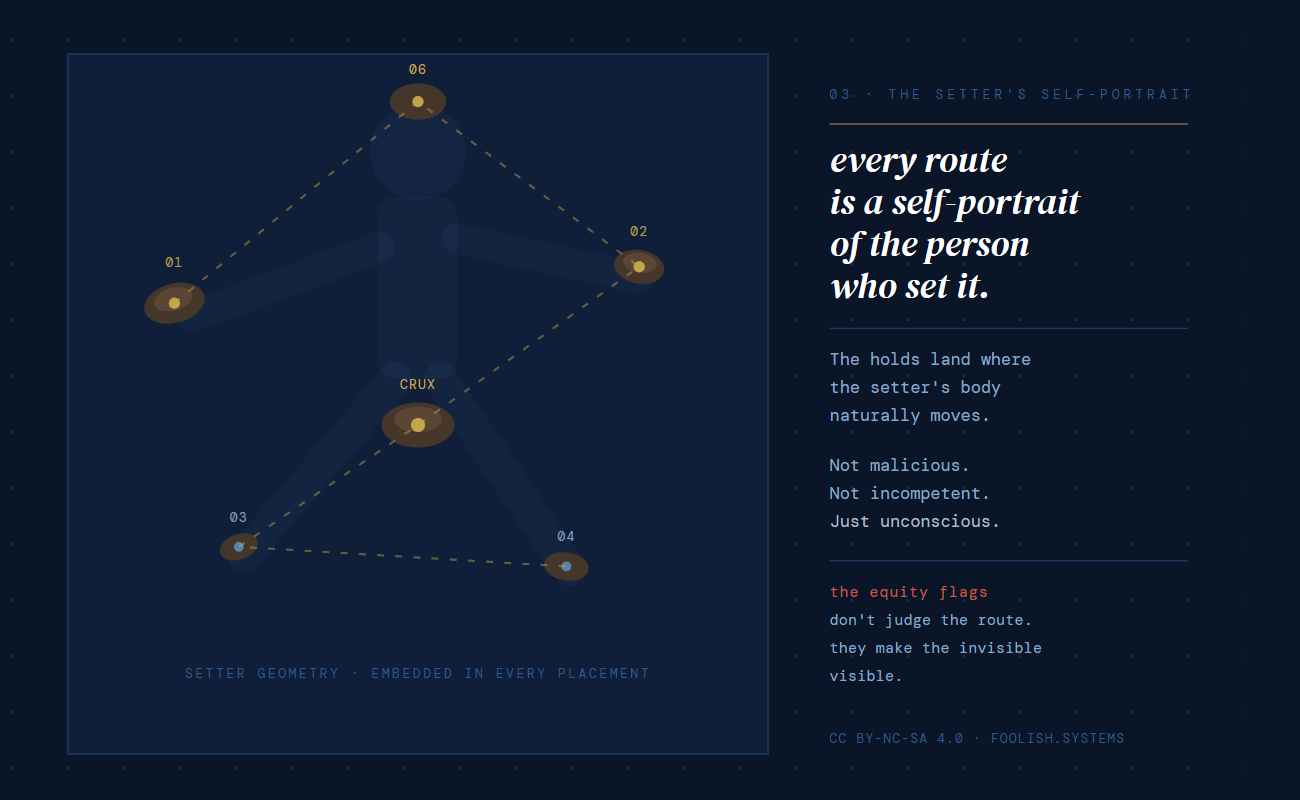
There’s a concept in route setting that doesn’t have a widely agreed-upon name, so I’ll use the one I’ve been using for years: splits beta.
Splits beta is what happens when a route’s intended movement sequence only works for a specific body geometry. When your body doesn’t match those assumptions, you don’t just find the route harder. You find yourself inventing entirely different movement solutions that the setter never considered and the route wasn’t built to support.
Body variance isn’t a small-people problem. I want to be direct about that.
I’m 6’3” and 245 pounds and I’m a technical climber. I climb like I grew up on slab, because my body type forces the issue. I coined the term splits beta because at my size, technical climbing requires movement solutions nobody named yet. Why fight a shitty hold when you can split across three foot holds and make the sequence actually work for your body?
I know incredibly strong climbers who have sent BRUTAL double digit boulders outdoors. But will read something in the gym, try it a few times and then go “nah” not worth it. When it happens once its an isolated incident. When it happens a lot its a pattern. When its 6 grades below their redline. its a category error. That is a route that encoded one specific body as normative for everyone.
Height distributions are not gender-neutral, and I won’t pretend otherwise. The gap in average height between men and women is real and documentable. In Hawai’i, where I’m from, the average height across the general population is markedly lower than the mainland — for men and for women. I can name this bias specifically because the people I set with — many of whom reaching the top shelf of their kitchen cabinets was a mantling opportunity on the counter — reinforced it every single time we did QA on a new set.
The credential structure doesn’t fix this. You can be a lead setter at a Boulder Project and still be setting for your own body without knowing it. Having a room full of setters with different bodies doing adversarial review of each other’s work is the only real mechanism I know of. Which is exactly what the equity flags in the route engine are trying to approximate.
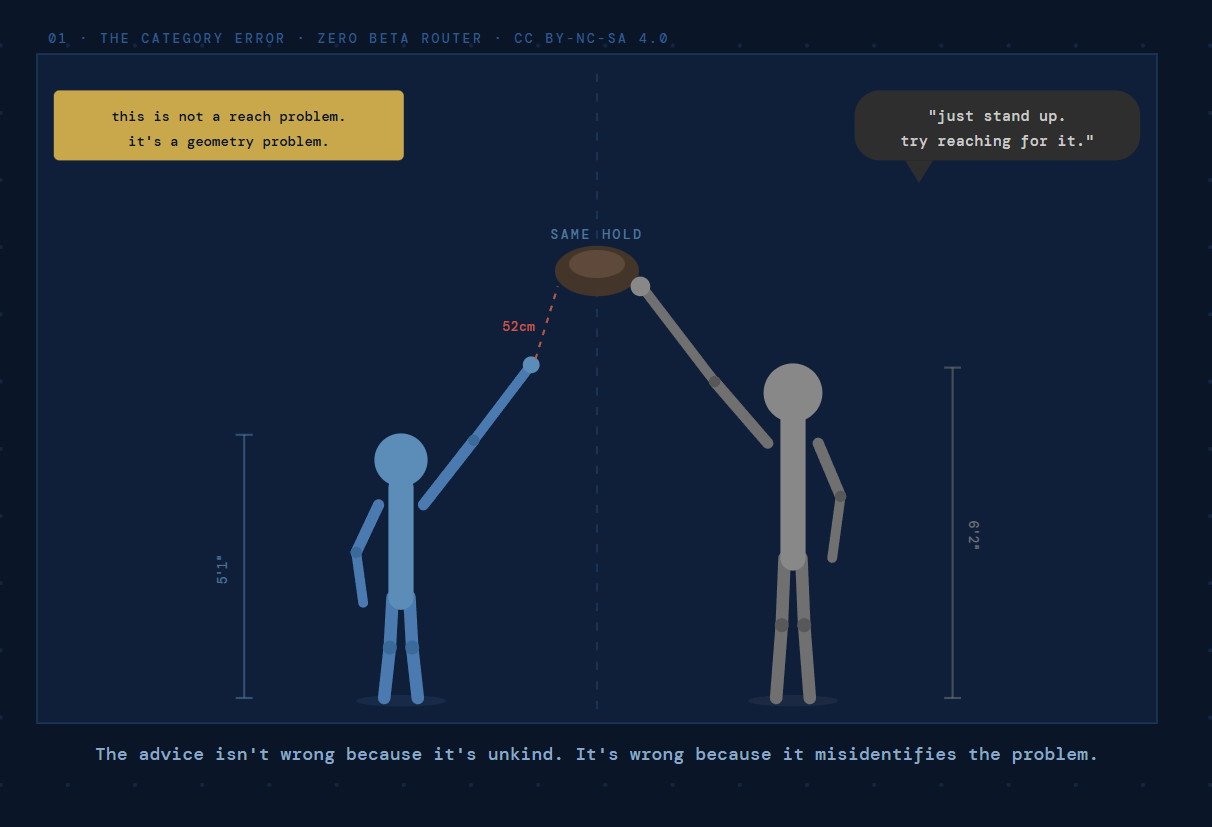
(Listen… You don’t want to know how many iterations it took just to get the graphic to this point. AI has real limitations. just not the ones you think. -ed)
The Pact
One of my long-term climbing partners is 5’nothing and weighs less than a weight plate. The fact that I trust this person to belay me more than almost anyone else in a world tells you everything you need to know about her, me, and what trust means in this world. She is also my soulmate in being industrial-strength petty when the situation calls for it.
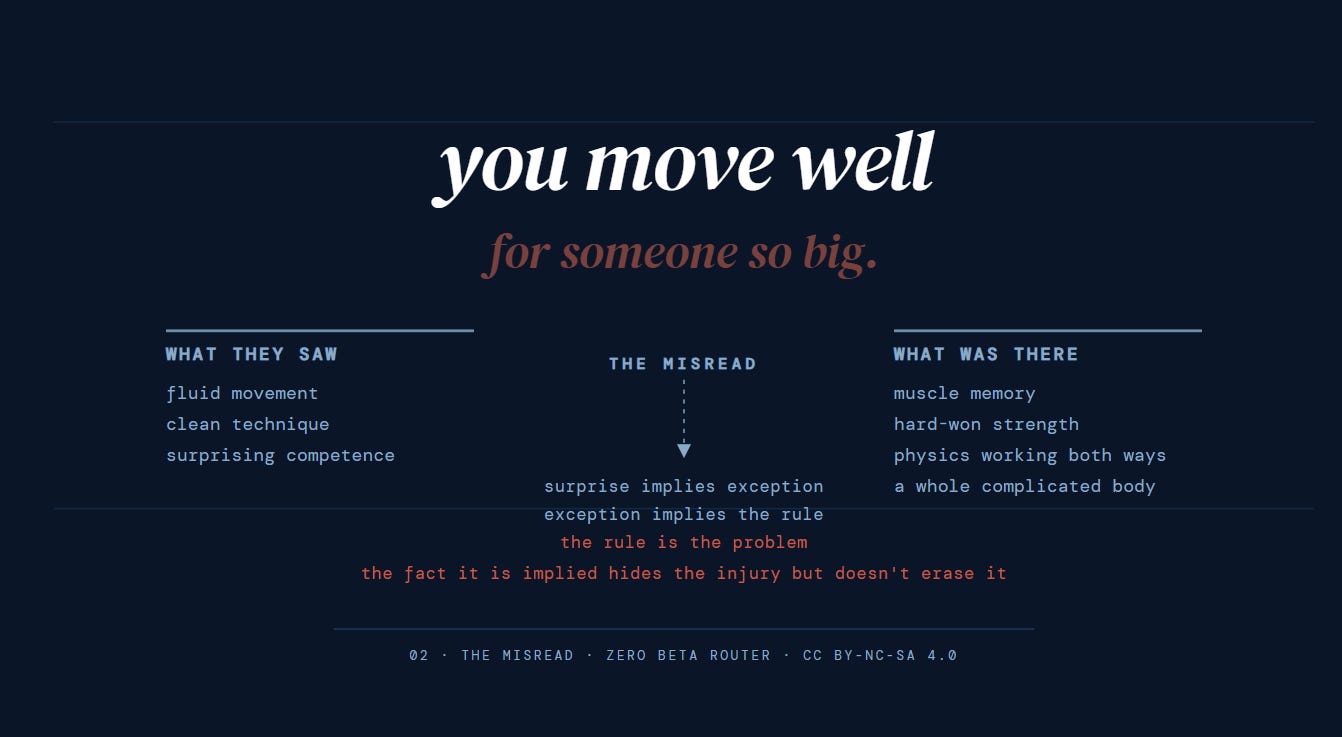
Years ago we made a pact. We were tired of having years of effort, training, and hard-won technique reduced to body mechanics commentary — “have you tried just standing up and reaching for it?” or “dude, you move so well for a big guy, maybe try [insert unhelpful dynamic advice designed for a body that is not mine].” So we created the most efficient category error correction function we could think of. We would politely thank that person for their unsolicited beta. Then we’d watch whatever route they were projecting or visibly struggling on. And without saying a word, we’d step up — ideally right after they ate it — and flash it.
Petty? Absolutely. The petty was the point.
But here’s what I noticed over years of doing this: without fail, whatever they were projecting was flashable for us. Not because we’re exceptional climbers. Because the category error propagates early, relies on people who don’t know enough to stop themselves from saying something stupid, and internally derives from setters who’ve baselined themselves as normative for everyone else on the wall.
The Mountain Argument
Here’s the pushback I hear, and it’s a real one: real rock doesn’t care. The crack is the crack. The sloper is the sloper. The mountain has no equity policy. Climbers adapt or they don’t.
That’s true. And it’s the argument for the equity tools.
A route setter is not a mountain.
A mountain accumulated over geological time with zero intention. A route goes up in an afternoon with a very specific brain behind every bolt. Every hold placement is a decision. Every sequence is an argument about what movement should look like, made by a human body that encodes its own geometry into every route it builds.
Real rock’s indifference produces genuine variance — cracks that only fit certain hand sizes, faces that reward certain reach spans, features that work for some bodies and not others. That variance is exactly why outdoor climbing is endlessly interesting. Indoor setting that unconsciously encodes one body type isn’t recreating real rock’s indifference. It’s recreating one setter’s body as if it were geology.
The route engine isn’t trying to make climbing fair the way a participation trophy is fair. It’s trying to make setting as genuinely indifferent as the mountain actually is.
The equity flags don’t moralize. They say: this hold combination, at this spacing, on this angle, creates a movement demand that falls outside the median reach envelope. That’s data. What you do with it is your call.
But you can’t make the call if you don’t have the data.
Being Seen
The 5’1” climber who sends V10 outside and gives up on a gym V6 because the crux is a dead point to a hold placed for someone a foot taller — she’s not just frustrated by the reach problem. She’s frustrated because the route is telling her, without malice, through accumulated choices made by someone who never thought about her body, that she wasn’t considered.
Every climber who’s ever done “wrong” beta and sent — they found a line that worked for their body because the intended line didn’t. That moment is partly triumph and partly quiet acknowledgment that you weren’t in the setter’s head when they built it.
The equity flags don’t solve this completely. But they ask the question: whose body did you forget? And being inside a tool that was designed to consider your reach, your weight distribution, your movement vocabulary — that’s not a small thing.
That’s the difference between a gym that’s technically accessible and a gym that actually feels like yours.
Why It’s Free
CC BY-NC-SA 4.0. Use it, modify it, distribute it, make it better. Credit Systemically Foolish. Keep the distribution free. Don’t bundle it into a product you sell.
A gym using it internally is not commercial use. The tool stays in the commons.
Route setting was always a profession that ran on community before it ran on money. We got paid in beer and beta and the satisfaction of watching a stranger stick a move we designed for them specifically. That was real. The tool stays free because the knowledge it’s built on was never ours alone to charge for.
The Zero Beta Router is being shared with Route setters Anonymous first because that community will tell us what’s wrong with the taxonomy, argue about whether we categorized volumes correctly, and submit photos of their own holds to populate the catalogue with real-world data.
That’s the point. The tool improves because the community uses it. Every improvement stays in the commons.
Go use it. Break it. Tell us what’s wrong.
Zero Beta Router is available Here per Creative Commons (CC BY-NC-SA 4.0)
Part Two Can Be Read Here
Systemically Foolish is systems engineering practitioner lab focused on deploying ethical sociotechnical systems that raise the floor for everyone
You can find out more about us here
If our content is informative, useful or simply amusing, please consider subscribing.
We hate SPAM mail as much as you do, believe your data belongs to you and above all
Systemically Foolish’s content is not paywalled and never will be.
Your subscribe helps us get indexed and thus found by others outside of direct links.
We are an independent organization with a primary focus on primary research and information distribution. If you would like to support us in our work, we would be grateful